battery

Safely moving dangerous goods

Lithium-Ion (Li-ion) batteries are a type of rechargeable battery that’s used commonly in electronic devices such as smartwatches and mobile phones, with demand for larger Li-ion batteries to power electric vehicles, but there are significant challenges in transporting these hazardous products.

The global penetration of smartphone and innovative technology means demand for smaller batteries, up to 4kg, will be sustained, while the move to electric vehicles is growing the market for larger batteries, which can weight in at >800kgs. But, given the hazardous nature of these products, planning and managing their safe transportation takes significant skill.

Metro personnel are trained and qualified in the packing, labelling and safe handling of Li-ion batteries and other hazardous cargo by every mode, including air, maintaining strong relationships with the air cargo carriers that will carry Li-ion batteries.

WHAT IT TAKES TO MOVE A 440KG LI-ION BATTERY TO THE US

An automotive manufacturer client needed a 400kg replacement Li-ion battery moved to the US via LAX asap. Because the battery exceeded 35kgs movement approval was first sought from the Civil Aviation Authority and then from the VCA, the UK authority for the certification of packaging for the transport of dangerous goods. Next we identified the most appropriate airline that would carry the battery - at the time there were only 2 carriers accepting Lithium Batteries under UN3480 - but as their flight plan took them over Europe we needed to seek additional approvals from the European air transport authorities.

This shipment in 2017 set the foundations for our Lithium battery platform and since then we have invested in the resource to serve this vertical, including training to cover all modes. Our Li-ion transportation expertise is increasingly recognised as market-leading, with our automotive team’s manager invited to address the International EV battery conference.

As li-ion batteries can store large amounts of energy and can be recharged many times, they offer the charging capacity and longer lifespan required to provide a reliable power source for electric, hybrid or plug-in hybrid electric vehicles.

With just one automotive manufacturer investing £1 billion factory that will make 100,000 lithium-ion batteries a year, it is clear that demand for the safe and efficient transport of these critical components, which is already significant, is going to be massive.

Despite its widespread adoption and energy-efficient storage, the Li-Ion battery can be a safety hazard if produced, used, or stored improperly, with numerous accidents, close-calls and safety breaches, leading them to be banned from passenger aircraft and subject stringent controls on all modes of transport.

The battery contains flammable electrolytes, which can become pressurised to the point of explosion should they sustain any structural damage, or be charged too quickly.

Because of this, and because of its widespread use in most commercial products, the safety standards and safety testing of Li-Ion batteries is much more stringent than other types of batteries.

Lithium-ion batteries are classified as Class 9 - miscellaneous hazardous materials (dangerous goods) and are subject to specific packaging, marking, labelling, and documentation according to the rule specified by the relevant modal authority: IATA (air); IMO (sea); ADR (road); RID (rail).

Due to the hazards associated with lithium batteries, there have been a number of changes to transport legislation and batteries are now assigned their own UN numbers:

UN 3090 — lithium metal batteries (including lithium alloy batteries)

UN 3091 — lithium metal batteries contained in equipment, or lithium metal batteries packed with equipment (including lithium alloy batteries)

UN 3480 — lithium ion batteries (including lithium ion polymer batteries)

UN 3481 — lithium ion batteries contained in equipment, or lithium ion batteries packed with equipment (including lithium ion polymer batteries)

UN 3536 — lithium batteries installed in cargo transport unit lithium ion batteries or lithium metal batteries.

For further information please contact Heather Smith, our EV and battery expert for further advice and the latest market legislation and intel.

ECO Loadstar

Press review Metro’s digital ECO module

On the 1st July Metro launched its new ECO tool, to track and offset shippers carbon emissions within their supply chain. The following day, The Loadstar - the most respected and influential supply chain news portal - carried its review of our new product, which is repeated in full below.

METRO JOINS TOP FORWARDERS OFFERING SHIPPERS EMISSIONS MONITORING AND OFFSETS

Helping shippers achieve sustainability – a new, key demand – is no longer solely in the hands of major multinational forwarders.

Yesterday Metro Shipping, based in Birmingham, UK, led the way for independent forwarders as it launched an in-house-developed programme to help customers measure, reduce and offset their CO2 emissions.

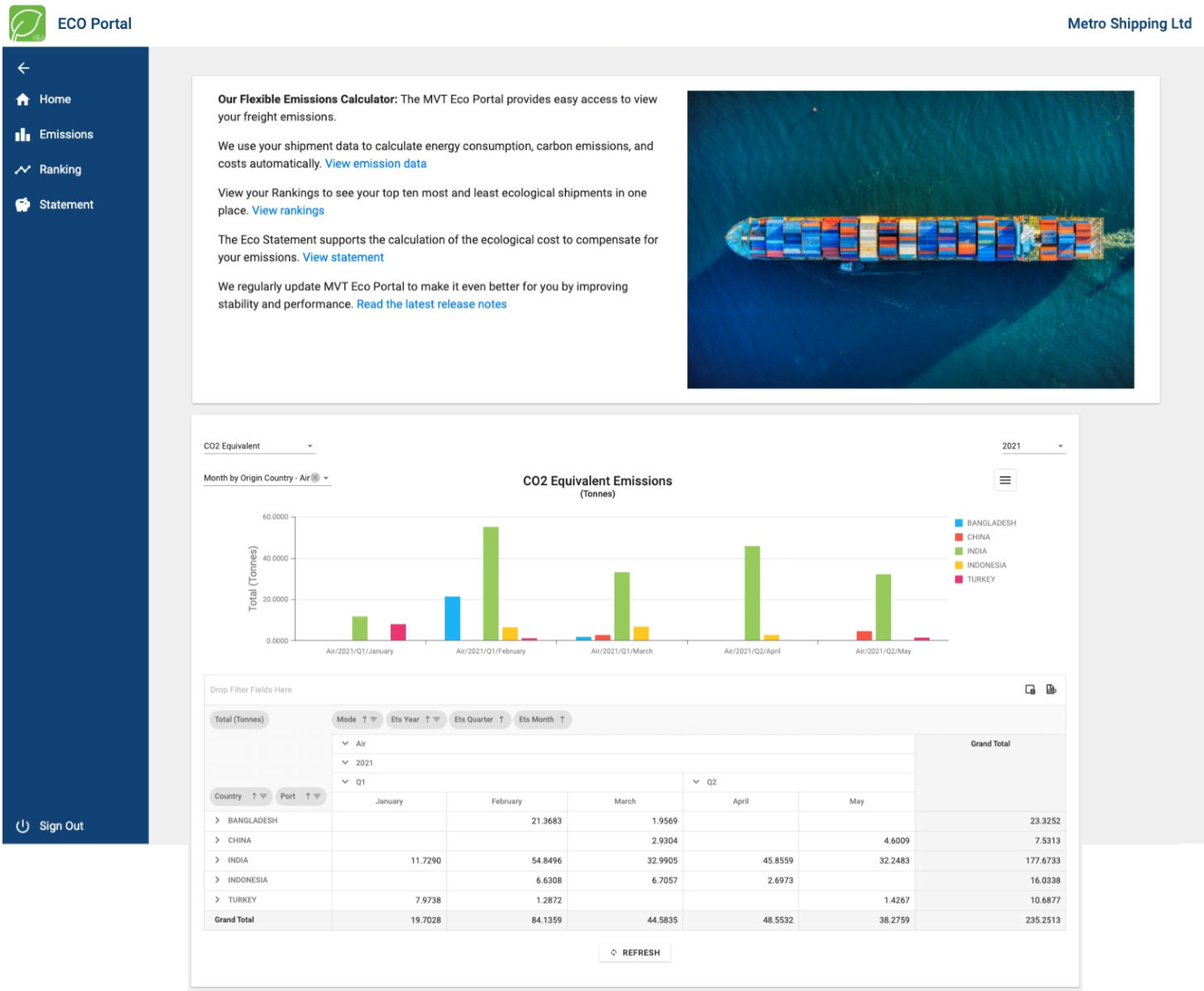
The free-to-use MVT ECO module, a cloud-based SaaS, monitors emissions  – and their costs – for every consignment in every mode, and enables shippers to choose how, or if, to offset them.

The move helps shippers with their Scope 3 indirect emissions measurements.

The free reports are verified and conform to European standards on consumption and greenhouse gas (GHG) emissions. It is also accredited by the Smart Freight Centre, using the Global Logistics Emissions Council framework.

Simon George, technical solutions director, explained: “The dashboard shows customers the emissions data, year, confirmed departure and CO2 equivalent. And it reveals the total cost to offset. You can easily flick between key metrics.”

Metro said it had decided to develop the technology after “half a dozen” customers started asking for data. But despite the demand, the forwarder said the real test for customers began now.

“Once you have measured the emissions, the second point is what you are going to do about it,” said Claus Rasmussen, director of information systems for Metro.

“Most companies don’t have a huge amount of impact – ie, no trucks or warehouses. But some have started to do something about things not in their immediate control. They will either have a CSR policy and a choice of offsetting, or they want to let their service provider do it for them.”

Using offsetting programmes offered by specialist Comply Direct, customers can choose how to offset emissions via the Metro platform.

“When the reporting is in place, we’ll select a portfolio of one to three products for Metro CO2 offsetting, which will be for projects of value. Generally, you can decrease CO2 by avoiding it, storing it, or offsetting the impact on the planet. By combining two or three, you’d have a good scope of offsetting,” explained Mr Rasmussen.

What has surprised Metro, however, is the scale of emissions, and the subsequent cost of offsetting.

“We are unsure what level companies will commit to. Some of the numbers can be fairly significant. We want to find out our customers’ interest in offsetting and get into a dialogue about a better choice, and maybe create different supply chain choices. Is air freight really necessary? Is road or rail better?

“There is a new dynamic in the talks we are having with customers,” added Mr Rasmussen. “For one thing, now we are not just talking to shipping and logistics departments, other customer departments are getting involved.

“Either way there is a cost to companies, of offsetting, or of avoiding offsetting. As we start getting into the analysis, we’ll start to see some trends. It’s too early right now, we are still checking the data.”

Mr George agreed: “It can come as quite a shock, how much they need to offset. Total offsets could be £6,000 in one month for a significant shipper.”

Metro’s cost reporting is based on two approaches: damage cost – ie, costs which compensate for the damage that has happened; and avoidance cost, which avoids damage. The latter is the more expensive, “on the high-side, up to £90 per tonne of Co2 emissions,” said Mr George.

“We are also allowing our users to select a damage cost approach, which defaults at about £15 per tonne, but can range between £5 and £100.

“That’s when the project chosen becomes important. Offsetting is a true marketplace, with market dynamics, but it also equates to a choice in where you want your money to go.”

Perhaps counter-intuitively, while freight rates are very high, there is less pressure on the purse for offsets.

“Adding $200 is not that big a deal on very high freight rates,” explained Mr George. “When the freight rates go down, the percentage becomes much higher. It can make a big difference.

“For us though it’s more about reporting at this stage, and making sure we capture all the pricing elements. Every time we get a quote from a carrier, we’ll look for standard pricing, and an eco option.

“If you had asked a year ago, customers would have shaken their heads. But now there is a continuous conversation about a less impactful choice. How can you identify better options alongside standard services? It’s built into the tech solution.”

Metro is now considering offering the platform to others.

“The cost of getting the data is reasonable, affordable, but knowing what to do with it is the hard bit,” said Mr George. “We are currently discussing selling to trade, or others in our group. Many companies are probably waiting for software companies to do it for them.”

Metro is also starting to look at sustainable fuel solutions and talking to potential partners, but Mr George said it was aware of its limitations, and the complexity of the market.

“We’re certainly not experts on what is and isn’t sustainable fuel, but we do present all the market options to customers so they can make their own choices on the matter.” he said.

Author: Alex Lennane

You can view the original article on The Loadstar

For further information on how we can help and proactively assist you in reducing our own carbon footprint within the supply chain, and beyond, please contact Simon George who will be delighted to engage and set up a demonstration and discussion to further encourage and promote this initiative.

ECO globe

Metro’s ECO tool launches today – tracking and offsetting your carbon emissions within the supply chain

The new MVT ECO module that is launched today, with selected customers, monitors the energy emissions, emission costs and CO2 equivalent emissions, of every consignment we move, by every mode, so that shippers can monitor and have the option to offset their CO2 emissions.

As a non-asset owning 3PL, 99% of our carbon footprint is generated by our customers’ shipments on planes, ships and trucks, that we do not own or operate, but this does not diminish our determination to be carbon neutral and support our customers’ in achieving the same ambition.

By working with customers, suppliers and carrier partners we are measuring, reporting and offsetting emissions, to build greener supply chains that drive down CO2 and waste. We forecast a swift uptake, and encourage this as soon as possible, and we will keep on launching new initiatives to ensure that we contribute to reduced climate change, intelligent freight movement and sustainable development in the future, for all the reasons that are now becoming critical.

The MVT ECO module is a cloud-based, software-as-a-solution, that is available, free-of-charge, to all our shippers on their MVT dashboard, where they can view key eco statistics related to their movements, to see which areas will benefit most from emissions offsetting and where efforts can have the most impact.

To ensure our customers can have confidence in the data, our free emissions reports have been verified and conform to EN16258 for the calculation and declaration of energy consumption and greenhouse gas (GHG) emissions.

The MVT ECO data hub consolidates emission data across all routes and transport modes and is accredited by Smart Freight Centre (SFC) with reporting methodology that is in conformance with the Global Logistics Emissions Council (GLEC) framework.

We are working with Comply Direct to help to source Verified Carbon Standard offsets and support a number of verified carbon offset projects including renewable energy and natural resource conservation, for customers wanting to offset the emissions associated with their shipments. 

Visit the MVT ECO portal web page

OR

Request a demo and see how easy ECO reporting is
In a one-on-one demo we show you how MVT ECO collates a customer’s carbon emissions data across carriers, modes and origins, with click-through interrogation and simple summaries that can be used for reporting, sustainable supply chain planning and offsetting.

ecoportal

Metro’s ECO portal prepares for July launch

The new MVT Eco module monitors the energy emissions, emission costs and CO2 equivalent emissions, of each consignment we move, by every mode and will be available free from the 1st July, which means that Metro customers can monitor the environmental impact of their supply chains and participate in offset projects that will eradicate their CO2 footprint.

As a non-asset owning 3PL, 99% of our carbon footprint is generated by our customers’ shipments on planes, ships and trucks, that we do not own or operate, but this has not diminished our determination to be carbon neutral and support our customers in achieving the same ambition.

Consumers and corporate B2B customers are more aware of their carbon footprint, and there is increasing demand for goods, services and suppliers with a reduced environmental impact.

Companies who monitor, understand and minimise their carbon emissions have an advantage, creating an opportunity for differentiation based on sustainable practices.

We are creating innovative supply chain solutions that will help our customers to reduce CO2 emissions, set sustainability goals and achieve their environmental targets. 

Originally designed as part of our 4PL platform, the MVT Eco module will be available via our new MVT Portal. Customers can view key eco statistics related to their movements and export this data for further internal analysis.

To ensure our customers can have confidence in the data, our free emissions reports have been verified and conform to EN16258 to calculate and declare energy consumption and greenhouse gas (GHG) emissions.

The MVT ECO data hub consolidates emission data across all routes and transport modes. It is accredited by Smart Freight Centre (SFC) with reporting methodology in conformance with the Global Logistics Emissions Council (GLEC) framework.

We are working with Comply Direct to help source Verified Carbon Standard offsets for customers wanting to offset the emissions associated with their shipments.

CO2 by origin
Cost by mode
ECO statement
CO2 country example

Subject to third party verification to one of the leading standards for voluntary offsets, these are a robust and reliable means to offset carbon emissions. In line with the UN sustainable development goals, the projects on offer also include additional community, social, environmental and biodiversity benefits. 

Examples of project types include protecting the Amazon rainforest, providing clean cookstoves to communities currently cooking on open fires, and delivering renewable energy to areas currently not on the grid.

MVT ECO will be officially launched on 1st July and is available to all customers, with simplified adoption and set up, to encourage adoption by our entire client base, with minimal disruption.

  • Track emissions for every shipment by route and modes of transport
  • Dynamic data, simple to interrogate
  • Aligned with the Global Logistics Emissions Council
  • Supply chain auditing to reduce your carbon footprint
  • Advice, guidance and offsetting initiatives to achieve your sustainability goals

For more information or to request a demo of the MVT ECO Portal, please contact Simon George EMAIL, who leads our technical solutions team.

To discuss carbon reduction strategies and the availability of offset projects, please contact Claus Rasmussen EMAIL.