
ECO globe 2021

Supporting environmental transparency

Environmental reporting standards for business have been high on the agenda at the UN’s Climate Change Conference – COP26 – currently underway in Glasgow and Metro support the drive for businesses to be open about their impact on the planet, as transparency is an essential precursor for reaching global solutions to a global problem.

Companies’ response to climate change is arguably the most pressing issue facing society, which is why the UK government has joined 38 international partners to welcome the establishment of new international sustainability reporting standards at COP26. 

As a disclosing company, Metro is among the 13,000 corporations that have committed to environmental transparency, by disclosing our environmental impact and working to reduce greenhouse gas emissions, safeguard water resources and protect forests.

While world leaders gathered to discuss the future of climate change and their negotiating teams are hard at work at #COP26, we hope that our customers, and the wider industry, will also take action on climate change, because it poses a present and future risk to supply chains. 

It is only by measuring our environmental impact, that companies can understand and mitigate now, to prepare for the future and ultimately remain competitive – especially as there is increasing demand for goods, services and suppliers with a reduced environmental impact. 

Metro’s MVT Eco module monitors the energy emissions, emission costs and CO2 equivalent emissions, of each consignment we move, by every mode, which means that Metro customers can monitor the environmental impact of their supply chains and participate in offset projects that will eradicate their CO2 footprint.

The MVT ECO module is a cloud-based solution, that is available, free-of-charge, to all our shippers on their MVT dashboard, where they can view key eco statistics related to their movements, to see which areas will benefit most from emissions offsetting and where efforts can have the most impact.

To request a demo or discuss your requirements, please contact Simon George, who leads our technical solution team, or Claus Rasmussen to discuss carbon reduction strategies and the availability of offset projects.
VIEW MVT ECO WEB PAGE

MM 5

THE industry trade show returns – Multimodal 2021

After a break of more than two years the UK freight industry’s only dedicated conference and exhibition - Multimodal - has returned to Birmingham’s NEC centre and, as it is just down the road, we’ve popped in for a look around.

While the various COVID lockdowns and restrictions played out, Mutimodal suffered repeated postponements, denying the industry its annual opportunity to meet and greet.

Exhibitors are a mix of carriers, hauliers, ports, 3PL’s, trade associations and suppliers into the sector.

New for 2021 is the British International Freight Association’s (BIFA) village, designed to provide a marketplace for BIFA members to showcase the products and services they offer.

As a BIFA freight service award winner Metro were entitled to a free stand within the village but, due to the exceptional supply chain challenges we are currently facing, our priority is supporting our customers. Which meant we could not release senior team members for the three days that Multimodal runs, and have had to forego the opportunity to exhibit.

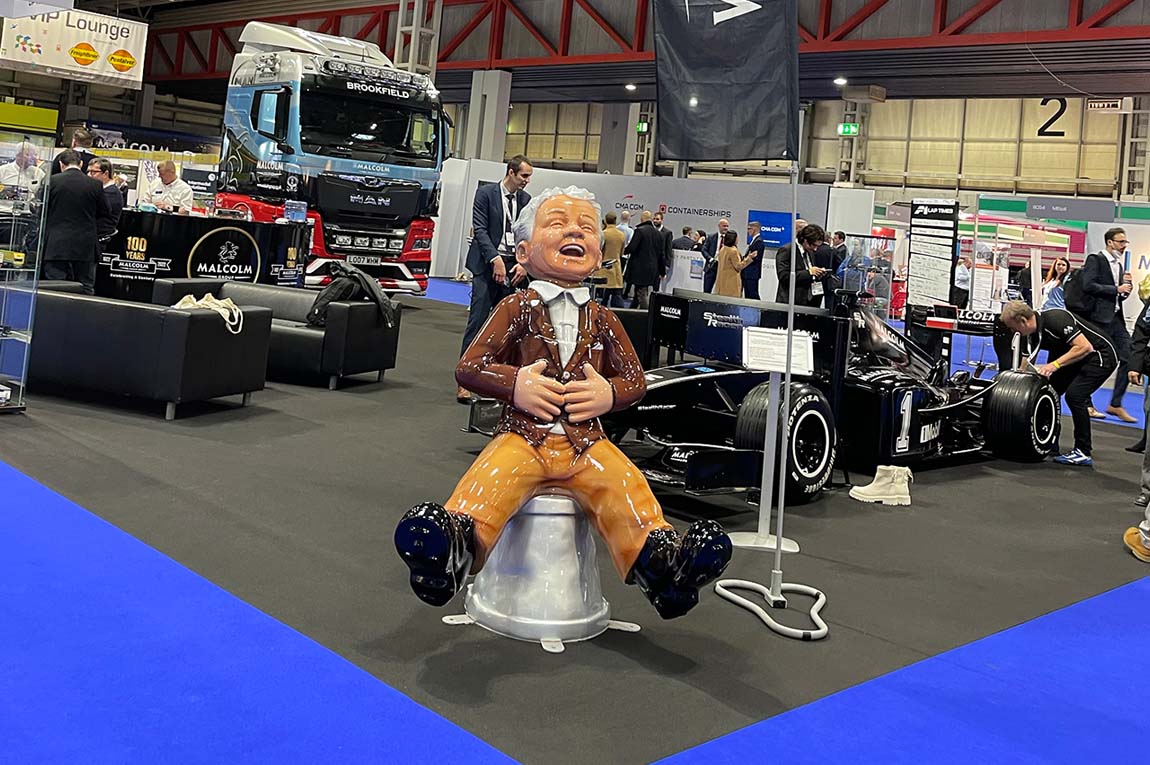
While we couldn’t spare colleagues for three full days, we have taken the opportunity to pop in for a quick look around, take these pics and see one of our team participating in one of the popular seminars.

This year’s seminar programme has been developed by Logistics UK, to share insight and best practice and “explore how technology, innovation and people power are driving a new business landscape.”

Day 3 of Multimodal  will see BIFA take the lead role in a seminar programme, supported by Metro’s Colin Smith (Training & Career Development Manager) that focuses on attracting young talent to the sector; with an examination of apprenticeships that are available; the trade association’s recently launched schools engagement programme, as well as the work being done by BIFA's Young Forwarder Network.

Feedback on the seminar sessions is interesting, particularly the most popular ones, as they explore the way forward for businesses in the supply chain. 

The most consistent theme is that supply chain has never been in the public eye, like now and it is critical that we raise the profile of the sector and it’s role within the wider economy and in particular to use this opportunity, as Colin highlights, to attract the next generation into the industry.

The HGV crisis came up consistently, but so too did sustainability and the need to look at every supply chain element, because we need to protect the future.

And in protecting the future, there were calls to ensure that EU suppliers and operators are fully prepared and ready for the 1st January 2022, as businesses will not be able to delay making import declarations and if you use ports that operate the pre-lodgement model or the Goods Vehicle Movement System (GVMS), full import declarations will be required before the UK Border.

Career at Metro

Inspiring the next Metro generation – a platform for a logistics career

The British International Freight Association (BIFA) the freight forwarding trade association is launching a campaign to encourage schools to promote careers in logistics, forwarding and the supply chain, and Metro is helping them, with public-speaking support at Multimodal.

The COVID pandemic has highlighted the importance of supply chains and the role of the freight forwarder in maintaining the flow of products and with schools returning for a new academic year, BIFA has committed to promoting careers within the freight and logistics sector to students.

Carl Hobbis, BIFA executive director and training development manager, says: “Since the Brexit vote and the onset of the Covid pandemic, global supply chains have been in the news more than ever, so what a great time to encourage someone to consider a career in the international freight sector that manages those supply chains.”

Apprenticeships are certainly something that a lot of students are considering, rather than taking on the debt associated with a degree, and there is a specific apprenticeship standard for International Freight Forwarding, that Metro helped BIFA in establishing over three years.

Metro apprentices complete the International Freight Forwarding Specialist Apprenticeship (IFFS) over 18 months, in an immersive, on-the-job, learning experience, that covers the complexities of air, sea and surface freight.

At higher education Metro engages directly with regional universities to introduce the logistics and supply chain sector to undergraduates, with the opportunity to experience a wide range of tasks and responsibilities, during a placement year.

At the forthcoming industry expo, Multimodal, which takes place at the NEC from the 19th to 21st October, Colin Smith, Metro’s Training & Career Development Manager will join a panel discussion with BIFA’s Carl Hobbis, to consider ’How to implement an effective apprenticeship scheme’. (SEE BELOW)

Colin commented. “It is really gratifying to see how our apprentices have progressed within the business and flourished professionally, since joining Metro with no prior knowledge. 

The International Freight Forwarding Apprenticeship course provides a really solid foundation for their career and encourages them to learn more, whilst retaining a focus on core capabilities.”

“My most pressing challenge is finding the next apprentice, the next undergraduate and the next cohort of graduates, by re-engaging  with local universities, colleges and schools, that took such a hit at the start of the pandemic.”

We are actively seeking new apprentices and are recruiting in other more experienced roles. If you, or someone you know, would enjoy working with a progressive colleague-focused business, please send us a CV, with covering letter to cv@metroshipping.co.uk

How to implement an effective apprenticeship scheme
MULTIMODAL 2021
21st October 10.30-11.30 - PORT OF TYNE THEATRE
Carl Hobbis BIFA (Chair)
Colin Smith, Metro Shipping
Marnie Rose, Seetec Outsource Training & Skills
Click HERE to register for Multimodal and join the event

For a fulfilling career with many opportunities please contact Colin and we will consider your application and respond to you immediately. As we continue to expand as a business one of our key priorities is to encourage new people to join Metro and our industry, providing a consistent and reliable career path for all our colleagues.

Brexit red line

Brexit delay, dithering and duties: Metro has your back

To the consternation of many shippers, the Government is changing the start dates for new border checks and processes for imports and exports with the EU. The good news is that Metro’s experts can protect your supply chain from these changes and simplify customs compliance, with our intelligent, automated, digital solutions.

With three significant Brexit changes and developments already this month, it is clear why so many businesses trading with the EU are confused, uncertain and concerned about changing customs regimes, requirements and compliance.

Metro’s dedicated customs brokerage team, is one of the industry’s biggest, most experienced and best resourced. It is a unique repository for EU/UK Brexit expertise and a flagship for graduate professional development in a critical area.

Continuing investment in technology and the brokerage team has expanded the capacity of our groundbreaking Customs Document System - CuDoS - and the capability of the advisory, support and compliance resource we provide businesses that trade with the EU. 

The proprietary CuDoS embraces proven, new and emerging technologies including optical character recognition, to convert documents into digital data. With automation technology, machine learning and artificial intelligence, to simplify and automate declarations, CuDoS is constantly adapting to ensure compliance with change UK/EU customs regimes.

CuDoS: 2021 Brexit stats:

  • 74% of workflow automated
  • 15,000 export declarations
  • 6,000 Transit accompanying documents
  • 12,000 import declarations
  • 99% analog to digital accuracy
  • 8 minutes = record declaration turnaround
  • 85% of clearances turned around in under 2 hours

Importers pay more post-Brexit duties

UK importers have paid 42% more in customs duties since Brexit came into force on the 1st January, largely to the “rule of origin” tariff, which applies to goods imported from the EU which were originally made, or contain components made, outside of the EU.

UK importers are paying more duty and UK Customs is losing out on hundreds of millions of pounds, as importers fail to comply with the delayed declaration scheme set up to soften the impact of Brexit.

Delays cost business

Delayed customs declarations are not being converted into actual customs declarations and while some importers may be happy to import without declarations while they can avoid them, they do face the very real prospect of retrospective action and auditing by HMRC, to recover outstanding taxes and duties.

The decision by the UK government to further delay Brexit border controls has been criticised by trade associations who believe that if these controls were imposed on EU suppliers, it would cause friction that might encourage a negotiated relaxation in controls between the UK and the EU and is to the detriment of UK companies.

Under the revised timetable:

  • Pre-notification of Sanitary and Phytosanitary (SPS) goods, which were due to be introduced on 1st October 2021, will now be introduced on 1st January 2022.
  • Export Health Certificates, which were due to be introduced on 1st October 2021, will now be introduced on 1st July 2022.
  • Phytosanitary Certificates and physical checks on SPS goods at Border Control Posts, due to be introduced on 1st January 2022, will now be introduced on 1st July 2022.
  • Safety and Security declarations on imports will be required as of 1st July 2022 as opposed to 1st January 2022.
  • Exit safety and security declaration applies from the 1st October 2021. An EXS is required  for a range of situations including, empty pallets, containers or a vehicle being moved under a transport contract and goods moving under transit.

Available, for the first time, to new customers, our CuDoS customs brokerage platform is optimised continuously, in line with the regimes in force on both sides of the Channel. Automating and submitting customs declarations, CudDoS simplifies compliant border processing, in either direction. 

We simplify declaration submission and safeguard our customers EU supply chains from the potential fallout of easement and regime changes, which means that their EU/UK movements will not be interrupted when full UK/EU border controls are implemented on the 1st January 2022.

To discus your situation and to learn how we automate customs declarations for businesses of all sizes, please contact Elliot Carlile or Grant Liddell who can talk you through the options.