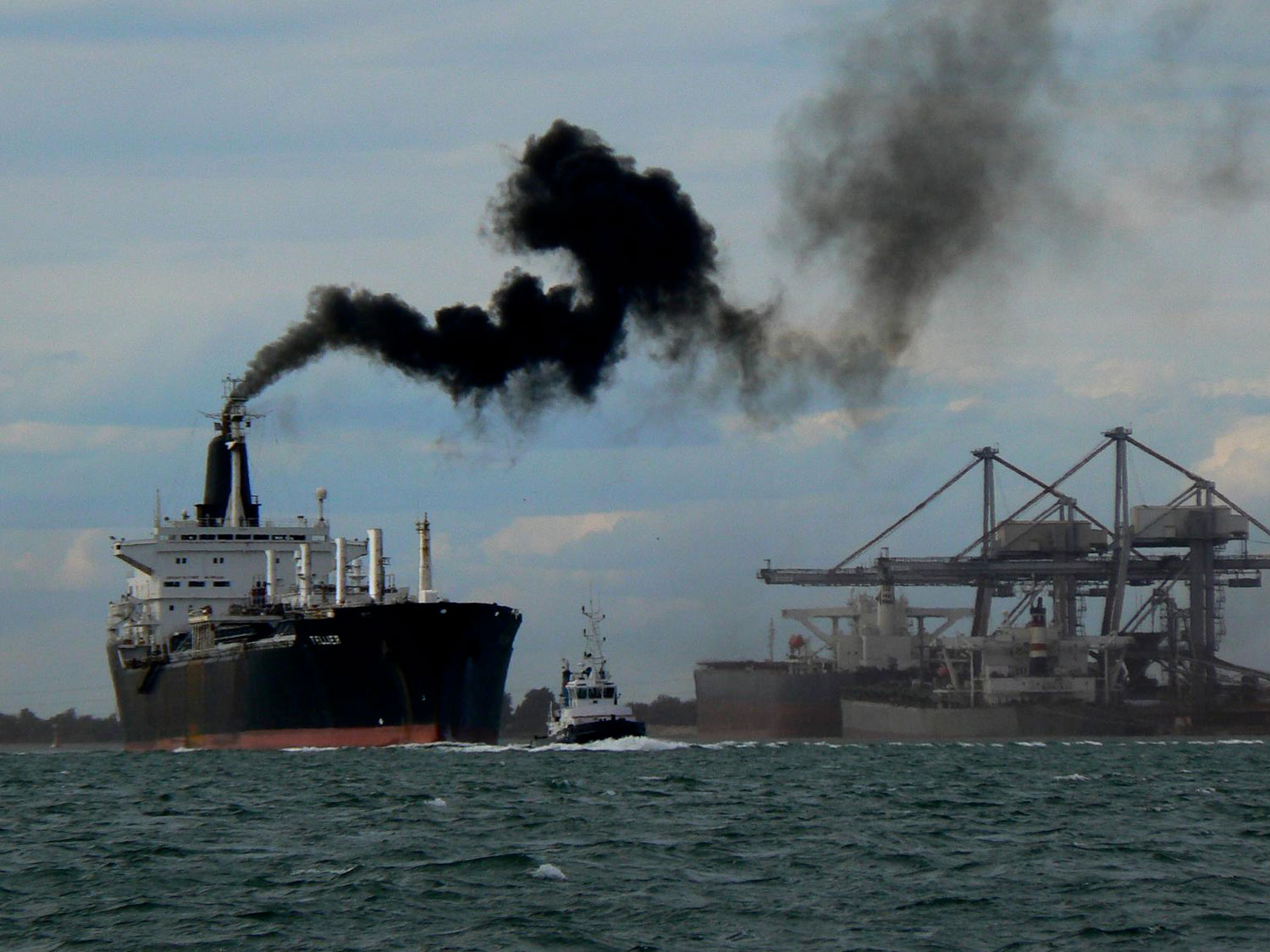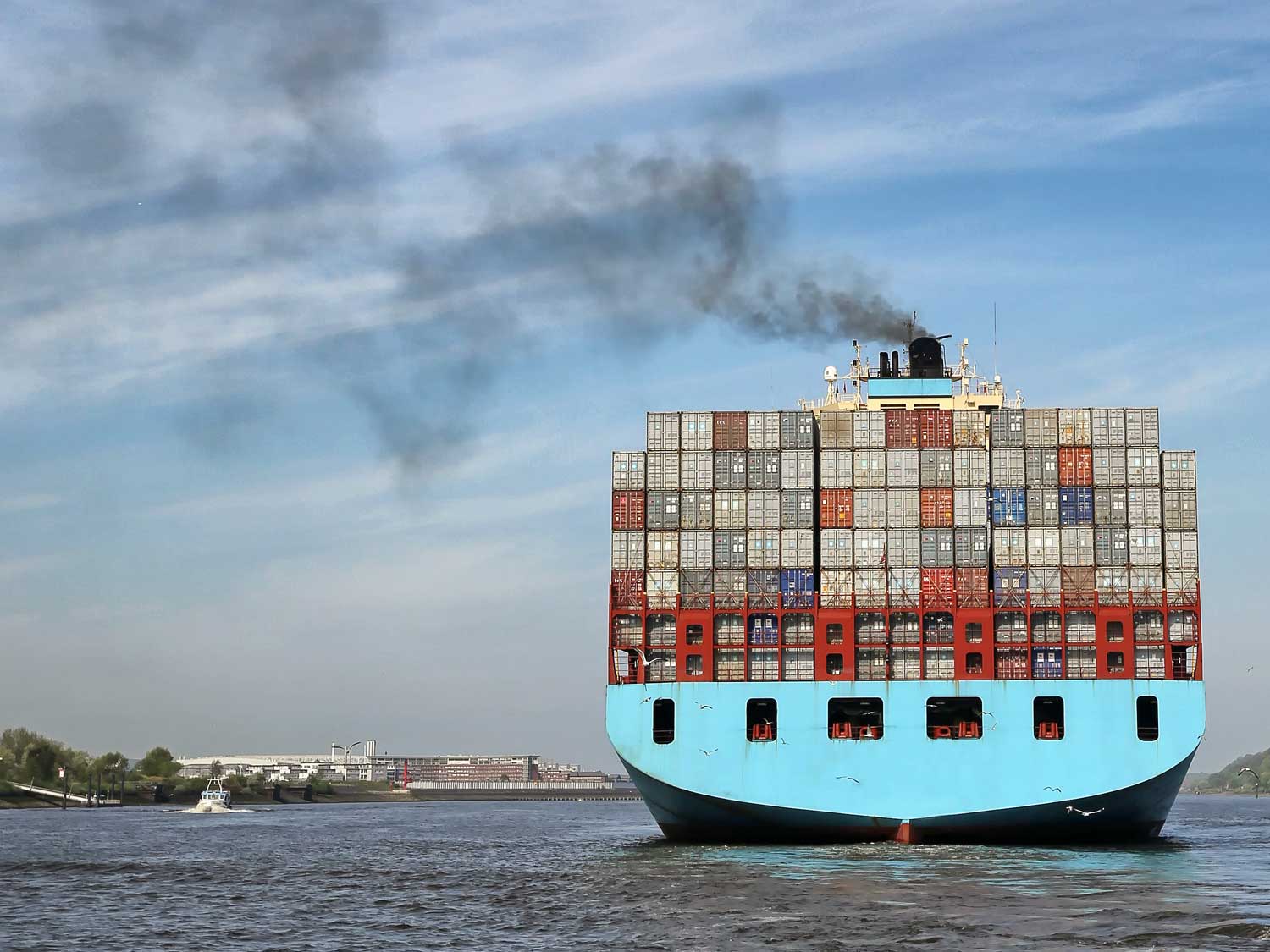
If you use ocean freight you can’t ignore IMO 2023 – what is it?…read on to find out the implications.

If you use ocean freight you can’t ignore IMO 2023 – what is it?…read on to find out the implications.

The supply chain challenges that have been driven by the pandemic and continue today with endemic congestion and disruption are significant and need attention, but preparation is needed for significant changes and challenges that are waiting just around the corner.

For close on two years everyone’s attention has been focused on operational, congestion and disruption challenges and when talk turns to the future, it is almost exclusively focused on when transit times will come back down, shipping schedules become accurate and freight rates return to sensible levels, rather than the International Maritime Organization (IMO) 2023 rules aimed at reducing emissions from vessels, which come into force in just 12 weeks.

On 1st January 2023 the IMO will adopt revisions and make additions to its initial strategy to cut greenhouse gas (GHG), by targeting vessel efficiency and carbon intensity to reduce total GHG emissions from shipping by at least 40% from 2008 levels by 2030.

Vessels will need to meet a specific Energy Efficiency Existing Ship Index (EEXI), have an enhanced Ship Energy Efficiency Management Plan (SEEMP) that lays out the vessel’s energy efficiency improvement steps, and determine Carbon Intensity Indicator (CII) rating scheme.

The CEO of a leading carrier explained that to improve the energy ratings of old ships you either use biofuel, or you have to slow the vessels down and calculated that his line would lose between 5 and 15% capacity to comply by lowering speed. This is a major impact on supply chain speed to market that is imminent in being implemented.

The IMO 2020 low-sulphur rules, were well-known for a decade before implementation, yet many only started to devote effort into the issue as we got into 2019 and many shippers only became aware in the second half of 2019 and were very surprised.

The soon to be introduced IMO 2023 rules were agreed upon in 2018, giving five years to prepare and while the new rules will involve carriers having to slow some of their vessels in order to meet the new requirements, the number of vessels affected and how much this will potentially reduce global capacity is presently unknown.

IMO 2023 rules will be more difficult for older vessels than for newer, more fuel-efficient vessels, and could have a more profound impact on smaller regional trades than major deep-sea trades, where most new tonnage operate. 

Shippers that source in alternative regions and smaller locations dependent on feeder services, may find that effective capacity is reduced, services cut and transit times extended.

The IMO 2020 rule change was comparatively simple to explain – “We need to buy more expensive fuel – and while the IMO 2023 rules are more difficult to communicate, their impact on the supply/demand balance in some trades will be very clear.

It helps a little that the entry into the new IMO 2023 is not a “big bang”, as was the case with the low-sulphur rules and will come into effect over time, as vessels get to their next certification, but presently it appears the market is on track for a repeat of the IMO 2020 debacle where many shippers felt it was a surprise sprung on them at the last minute.

Global supply chains are going to be under pressure for a while yet, and we will share the most important IMO 2023 developments so that you are informed and prepared to make critical decisions. 

Please contact Elliot Carlile, or Andy Smith to discuss your supply chain expectations and the potential impact of IMO 2023.
Lines set to impose new round of increased fuel surcharges for Q2

Lines set to impose new round of increased fuel surcharges for Q2

The sea freight bunker industry has been undergoing significant change since the introduction of the IMO2020 rule and the impact of measures taken in response to the Coronavirus pandemic have contributed to major shifts in oil market dynamics, with rising prices encouraging shipping lines to increase their BAF surcharges from April 1st 2021.

The Bunker Adjustment Factor (BAF) is an additional surcharge levied by all cargo shipping lines to compensate for the fluctuations in the fuel prices and make up for the extra charges incurred during the shipment of goods. The general system applied by carriers is to review the cost of marine fuel every three months against market indexes and real costs and apply a formulae based on the previous quarter to the current surcharge levels and show this as a separate cost for transparency.

Also called ‘Fuel Adjustment Factor’ or ‘Bunker Surcharge’, BAF is based on Twenty-foot Equivalent Unit (TEU) and varies according to the trade routes. It represents the floating price level of fuel in ocean freight shipping and is typically updated on a quarterly basis.

Ongoing optimism over global economic recovery demand, thanks to the rollout of Covid vaccines, has seen crude prices reach their highest levels in 13 months earlier this month. During the periods where the global oil markets have been supressed BAF charges have been very low or negated entirely under the mechanisms adopted by the shipping lines.

Low volatility in the past few months, and sustained consumer demand has seen the three main marine fuels increasing in cost since October and while there has been a light dip in the last week, the trend has been relentlessly up. This is demonstrated with the three graphs below.

In line with the increases on the VLSFO fuel cost per tonne during the 1st quarter and as demonstrated on the Ship & Bunker webpage. Therefore as widely reported, the shipping  lines are increasing the level of the Q2 BAF across all global trades (Export / Import and Crosstrade) in line with the agreed contract BAF mechanisms. Metro, will therefore also increase our BAF levels in line with this as a ‘pass through’ cost and updates will be sent in due course.

Please call Ian Barnes or Emma Hulbert for further information and updates, or any general enquiries relating to the BAF mechanism and current levels.

Making your supply chain carbon neutral

Making your supply chain carbon neutral

In an interview with the BBC, Maersk chief executive Soren Skou says greener shipping would cost the world’s biggest shipping lines billions of dollars and while he wants the consumer to pick up the bill, we think that low-cost action can be taken now to offset the carbon emission that shipping creates.

Shipping – which transports about 90% of global trade – is, statistically, the least environmentally damaging mode of transport and the industry, through the International Maritime Organization (IMO), is committed to reducing greenhouse gas emissions from ships by at least 50% by 2050.

In its latest reporting the IMO recorded 614 million tons of CO2 emissions by the global shipping industry in 2019, of which 30% (184 million tons) came from container shipping.

In 2019 the global container shipping fleet transported 170 million TEU, which equates to 1.08 ton per TEU, that could be offset in an appropriate carbon reducing programme for as little as $25-30.

For more accurate reporting, and to take other modes into account, we have developed an emissions tracking tool for our MVT platform that calculates offset options based on emissions per shipment, transport mode, routes and fuel types.

On 1st January 2020, a new limit on the sulphur content in the fuel oil used on board ships came into force. IMO 2020 limits the sulphurs in the fuel oil used on board ships operating outside designated emission control areas to 0.50% m/m (mass by mass) – a significant reduction from the previous limit of 3.5%.

Shipping lines installed ‘scrubbers’ to clean high-sulphur fuel, or switched to low-sulphur fuel, which shows the industry was ready to absorb a cost of $5.7 Billion for this, while carbon off-setting all containers shipped would cost iro $5.1 Billion.

All of the world’s leading carriers are investing in more environmentally friendly vessels, but it may not actually be until around 2050 that it is anticipated that we have an actual neutral fleet. Although his can be changed and influenced through responsible action and investment and brought forward.

Reducing sulphur emissions and developing green vessels is essential, but in principle Metro shippers could go neutral tomorrow.

We track CO2 emissions by shipment, mode, route and fuel type, using globally accepted standards and methodologies for measuring emissions. Although additional costs are attached to these initiatives it will deliver a measurable result. We are currently further developing the practices and processes that we have adopted over recent years to increase the ability to ‘go green’.

With standardised reporting, we provide a range of effective carbon offset options and our customers can review benchmarks, to compare carriersenvironmental performance to make informed buying decisions.

For further information, and to discuss your own concerns over this global issue, please contact Kevin Lake for further updates on the Metro approach and he will be delighted to discuss further and explain the detail.

Asia sea rates peaking

Asia sea rates peaking

Fuelled by volume reductions, IMO 2020 surcharges, and increasing demand ahead of Chinese New Year, Asia-Europe container spot rates are hitting levels not seen in years and could increase further in the run up to Chinese New Year.

The traditional Chinese New Year spike in demand, before factories close for the holidays, which start on 25th January, is filling ships and pushing up rates.

The steep increase in the price of very low-sulphur fuel oil (VLSFO) is another factor in the lines cost calculations, but how much of the additional cost of fuel is being recouped by the carriers remains unclear.

Demand, combined with the IMO surcharges explains some of the robust pricing, but the primary driver is the aggressive capacity reduction program of blanked sailings and the removal of a further 6% of capacity to fit scrubbers.

Many of the blanked sailings through January are within services offered by the Ocean Alliance and THE Alliance, although 2M carriers Maersk and MSC have extended the suspension of their joint AE2/Swan service until January. 

The withdrawn sailings are set to increase after the Lunar New Year, with carriers announcing significant capacity cuts. 

JOC report that shippers can expect an additional 4.7 average-sized sailings to be blanked, with the bulk of the announcements likely to come four weeks prior to Chinese New Year. 

The cuts will come on top of the already announced 162,000 TEU blank sailings for the period.

The uncertainty surrounding the IMO 2020 imposition continues. Carriers are already filling ships with the new fuel, but it is 83% higher than traditional high-sulphur fuel oil and carriers have stated repeatedly they have no intention of shouldering any of the increased fuel costs, and their success in passing them on to customers will heavily influence the deployment of capacity through 2020.

But as exposure to the rising fuel price grows, the real test of carrier discipline in passing on increased bunker costs will be come as demand starts to drop off after Chinese New Year and the traditional slack season that extends through March.