CBP 1440x1080 1

US importers face a new era of customs scrutiny

US import compliance is becoming more demanding, with Customs and Border Protection strengthening enforcement, scrutinising importer data and using technology to examine transactions long after goods have cleared the border.

From 18 September, inaccurate information held by US Customs and Border Protection (CBP) could result in an Importer of Record (IOR) losing the right to bring goods into the country.

The change may sound administrative, but its implications go much further. CBP is comprehensively reviewing importer records, while wider enforcement reforms are placing greater responsibility on businesses to demonstrate the accuracy of classifications, valuations, origins and sourcing decisions.

For importers already managing changing tariffs, suppliers and sourcing strategies, compliance increasingly needs to begin before cargo leaves origin and continue long after it arrives.

Importer responsibility starts before shipment

Under the new requirements, CBP can revoke import privileges when IOR information is inaccurate. That includes fundamental information such as physical addresses, telephone numbers and email addresses.

Crucially, responsibility remains with the importer even when a customs broker submits the information. Importers must ensure their records are correct when initially filed and remain accurate afterwards.

That principle extends across the customs process and cargo release does not necessarily mean CBP has accepted an entry as correct. Entries can remain subject to review during the 314-day liquidation process, while importers must retain supporting records for five years.

CBP is also becoming better equipped to identify inconsistencies. Investment in technology and AI means customs authorities can examine patterns across an importer’s history rather than treating every shipment in isolation.

That matters as businesses respond to tariff changes by switching suppliers, changing sourcing countries, restructuring transactions or altering declared values.

A legitimate commercial change can still attract attention if the customs data suddenly looks different. Importers therefore need records that demonstrate not only what changed, but why.

Relying solely on information supplied by overseas vendors or assuming a customs broker carries the compliance responsibility creates unnecessary exposure.

Importers should instead have visibility of the transaction before shipment, checking purchase orders, commercial invoices, quantities, product classifications, declared values and country of origin while there is still time to resolve discrepancies.

Broker oversight is equally important. Regularly reviewing customs entries against underlying commercial data can identify inconsistencies before they develop into a wider compliance problem.

CBP wants visibility deeper into the supply chain

The direction of travel suggests these requirements could become more extensive. CBP is consulting on proposals that could require importers to retain or submit overseas customs documentation, potentially including foreign customs entries, commercial invoices, packing lists and bills of lading.

It is also considering deeper disclosure of the upstream inputs and parties involved in producing foreign-sourced goods. Existing manufacturer information does not always provide the visibility CBP wants for enforcement purposes.

Taken together, the changes point towards a more data-led compliance environment in which CBP can compare US declarations with overseas documentation, supply-chain information and an importer’s historic trading patterns.

For US importers, several priorities follow: keep IOR contact and registration information current; validate classification, valuation and origin before shipment; retain the evidence supporting customs decisions; monitor brokers rather than simply delegating responsibility; and investigate unusual changes in customs data before CBP does.

Established practices also deserve scrutiny. “We’ve always done it this way” is increasingly difficult to defend when CBP can examine years of transaction history and ask for evidence that reasonable care was taken.

Compliance is therefore becoming an end-to-end supply-chain requirement rather than something addressed when cargo reaches the US border.

Metro combines international freight management with experienced US customs brokerage and compliance support, giving importers greater visibility and control from origin through clearance and beyond. 

We can help you validate shipment data, strengthen customs processes and identify potential compliance issues before they put your cargo, or your ability to import, at risk.

New York port 1440x1080 1

Transpacific capacity tightens as Panama restrictions reshape the market

Strong US import demand, reduced vessel capacity and tighter Panama Canal restrictions are keeping transpacific shipping under pressure, with East Coast services facing particular constraints as September approaches.

The transpacific market remains significantly firmer than Asia–Europe, despite signs that the recent rise in spot rates may be levelling off.

After several weeks of increases, Shanghai–New York spot rates slipped 2% in the latest Drewry World Container Index, while Shanghai–Los Angeles remained flat. Freightos recorded a different picture, with East Coast rates rising 3% and West Coast rates 1%. 

The differing indices underline the uncertainty surrounding the market rather than signalling a clear reversal. Rates remain substantially above levels seen three months ago, supported by resilient demand, constrained capacity and growing operational pressure around the Panama Canal.

Peak season demand remains resilient

An unusually early transpacific peak began in late May as US importers accelerated shipments from Asia, initially in response to tariff uncertainty and subsequently supported by continued demand.

China–US volumes fell 12% in the first quarter before surging 22% in Q2, with much of that rebound concentrated in April and May. US import forecasts suggest volumes could remain relatively firm through September before easing in October. 

Capacity has tightened at the same time. August capacity fell 9% month on month on Asia–US East Coast services, while carriers have continued using blank sailings to manage supply.

Congestion at Asian ports following successive typhoons has added further pressure, disrupting schedules and reducing the effective capacity available to shippers.

Panama compounds the East Coast squeeze

The Panama Canal is emerging as another important factor for Asia–US trade.

From early September, lower permitted draughts and fewer daily transits are expected to restrict the amount of cargo vessels can carry through the canal. Analysis of July movements suggests around 45% of Neopanamax transits could be affected by the new draught limits, representing approximately 55% of nominal container capacity using the larger locks. 

Initially, this may mean vessels carrying less cargo rather than carriers withdrawing ships. However, fewer daily transit slots could increase queues and delays while reducing the effective capacity available to East Coast services.

If restrictions become more severe, carriers could divert some Asia–US East Coast services around the Cape of Good Hope. That would add approximately 30% to transit times and tie up vessels for longer, tightening capacity elsewhere in the network.

West Coast gateways could gain cargo

Panama restrictions may also change how importers route US-bound cargo.

Some Asia-origin shipments normally moving through the canal to East Coast gateways could switch to Los Angeles, Long Beach and other West Coast ports, followed by rail or intermodal transport inland.

US intermodal volumes are already increasing as shippers respond to tight truckload capacity and higher road freight costs. Domestic container volumes grew 7.4% year on year during the first half, while international container volumes returned to growth in July. 

Rail networks currently appear to have capacity to absorb additional traffic, although localised pressure is emerging at some ports and railheads. A sustained transfer of transpacific cargo towards the West Coast could increase pressure on terminal appointments, chassis availability and inland connections during September.

Elevated conditions may persist into September

The immediate outlook remains finely balanced.

Strong transpacific demand contrasts sharply with Asia–Europe, where rates have declined for seven consecutive weeks. On the Pacific, however, capacity management, Asian port congestion and Panama restrictions provide continuing support for the market.

The latest pause in rate growth may therefore prove temporary rather than marking the end of peak-season pressure.

For shippers, the more important issue is increasingly where usable capacity will be available. East Coast constraints could favour West Coast routings, but shifting cargo west creates different inland transport requirements and potential congestion risks.

Early booking, additional lead time and the ability to switch gateways, routings and inland modes will be increasingly important as these pressures develop.

NOTICE: Transatlantic carriers push for September rate increases

Carriers are seeking to strengthen westbound transatlantic rates in September, despite softer demand between Europe and North America.

North Europe–US volumes fell 2.6% year on year in July, following a 5.5% decline in June, while Mediterranean–US volumes dropped 1.9%. In response, carriers reduced Europe–North America capacity by almost 9% during August, with a further 9% reduction expected on North Europe services in September.

Several carriers have now introduced peak-season surcharges and general rate increases, alongside higher European inland fuel and intermodal charges. With demand providing limited support, their success will depend on capacity discipline and shipper acceptance.

Metro connects an extensive Asian network with established operations across the United States, giving shippers access to alternative gateways, routings and inland solutions as capacity shifts. 

By considering ocean, port and inland costs together, we can identify the route that protects your supply chain and total landed cost and move with the market when conditions change.

EMAIL Andrew Smith, Metro’s Managing Director.

White House 1440x1080 1

US tariff uncertainty is becoming a permanent supply chain challenge

US importers face another period of significant trade policy change as the Trump administration expands its use of tariffs across countries, commodities and industries.

The immediate challenge is understanding which measures apply and how they interact. The wider issue is more fundamental: Section 301 is developing into a broad mechanism for imposing additional tariffs, while stricter customs enforcement increases the financial consequences of getting classification, valuation or origin wrong.

For importers, tariff exposure can no longer be treated as a temporary disruption. It increasingly needs to form part of sourcing, landed-cost and customs compliance decisions.

New tariffs broaden importer exposure

The latest changes follow the expiry of temporary Section 122 tariffs introduced in February 2026 after the Supreme Court overturned the administration’s earlier use of emergency powers for its ‘Liberation Day’ tariffs.

On 24 July, the administration introduced new tariffs on 59 countries and the European Union following a Section 301 investigation into goods allegedly produced using forced labour. The measures effectively restored a 10%–12% minimum tariff across economies responsible for around 99% of US imports, although significant product exemptions remain.

The UK was placed in the 10% group rather than the 12.5% tier applied to many other countries. There are product-specific exemptions under the UK-US Economic Prosperity Deal, so the 10% does not apply universally.

UK automotive exports benefit from a 10% tariff within the agreed 100,000-vehicle quota, aerospace goods have preferential treatment, and UK pharmaceutical exports secured 0% tariffs in April 2026. Different Section 232 or other measures can also apply depending on the commodity.

These duties can also stack on top of existing measures, helping push the estimated overall US effective tariff rate to approximately 10.8%.

Some individual measures go considerably further. Selected Brazilian goods face additional tariffs of 25%, while certain Canadian products have been targeted with duties of 50%. From 31 July, some pharmaceutical imports also became subject to tariffs reaching 100%.

More measures could follow. An investigation into excess industrial capacity covers 16 economies, including China, India, Japan and the EU, while further action targeting digital policies and specific industries remains possible.

The near-term outlook therefore points towards continued volatility rather than simplification. Importers should expect tariffs to change by country, product and policy objective, making total landed-cost calculations increasingly important when comparing suppliers and sourcing locations.

Enforcement raises the cost of getting customs wrong

Tariffs are only one part of the financial exposure. US Customs and Border Protection is also moving towards more aggressive enforcement.

Importers face increased scrutiny of the three areas fundamental to duty assessment: tariff classification, customs valuation and country of origin. Errors can result not only in additional duty assessments but potentially penalties where authorities believe tariffs have been avoided.

The scope for mitigating penalties may also be narrowing. Industry analysis indicates that reductions which historically could reach 90% are becoming less readily available, with mitigation potentially limited to around 50% for trusted traders able to demonstrate effective written controls and robust compliance procedures.

This makes customs governance increasingly important. Importers should review classifications, origin determinations and valuation methodologies before goods arrive rather than relying on retrospective corrections.

Procurement contracts also deserve attention. Businesses may need clearer provisions determining which party absorbs new tariffs and what happens if government action materially changes the economics of an existing sourcing agreement.

Tariffs are likely to remain part of the landscape

Legal challenges continue, including action involving 25 US states, but importers should be cautious about building their strategy around the prospect of tariffs disappearing.

Section 301 has expanded well beyond its previous association with China and is increasingly being used across different countries and policy objectives. Further investigations are expected, suggesting additional tariff announcements remain possible.

Even successful legal challenges may not deliver lasting certainty if the administration replaces overturned measures using alternative statutory authority.

For importers, this changes the emphasis from reacting to individual tariff announcements to building greater resilience into customs and sourcing strategies. That means modelling landed costs under different tariff scenarios, reviewing alternative origins and suppliers, maintaining accurate customs data and identifying opportunities to use legitimate duty-management mechanisms.

Metro’s growing US footprint combined with customs brokerage capability at every US gateway gives importers the support they need as tariff and enforcement requirements become more complex. Our teams can review classification, valuation, origin and duty exposure before cargo moves, identify potential customs risks and help you understand how changing tariffs affect your true landed cost.

With US trade policy changing quickly, don’t wait for a new tariff or customs intervention to expose a problem. Talk to Metro now about reviewing your imports, customs compliance and duty exposure. EMAIL Managing Director Andrew Smith.

Panama COSCO ship

Panama Canal constraints add another layer of pressure to transpacific shipping

The transpacific market is entering an even firmer phase, with stronger cargo demand, restricted vessel capacity and new Panama Canal constraints combining to increase costs and tighten space, particularly into the US East and Gulf coasts.

Spot rates indexes have continued to strengthen through the summer, with Shanghai–New York increasing 10% and Shanghai–Los Angeles rising 6% WoW. These rises extend the rebound seen since July and reflect sustained demand from Asia, with deliberate capacity management by the container shipping alliances.

Carriers cancelled ten transpacific sailings in each of the past two weeks, with another seven cancellations planned for this week. By removing capacity, lines are supporting vessel utilisation and rates at a time when congestion and equipment availability in China are already restricting effective supply.

Panama becomes a capacity issue

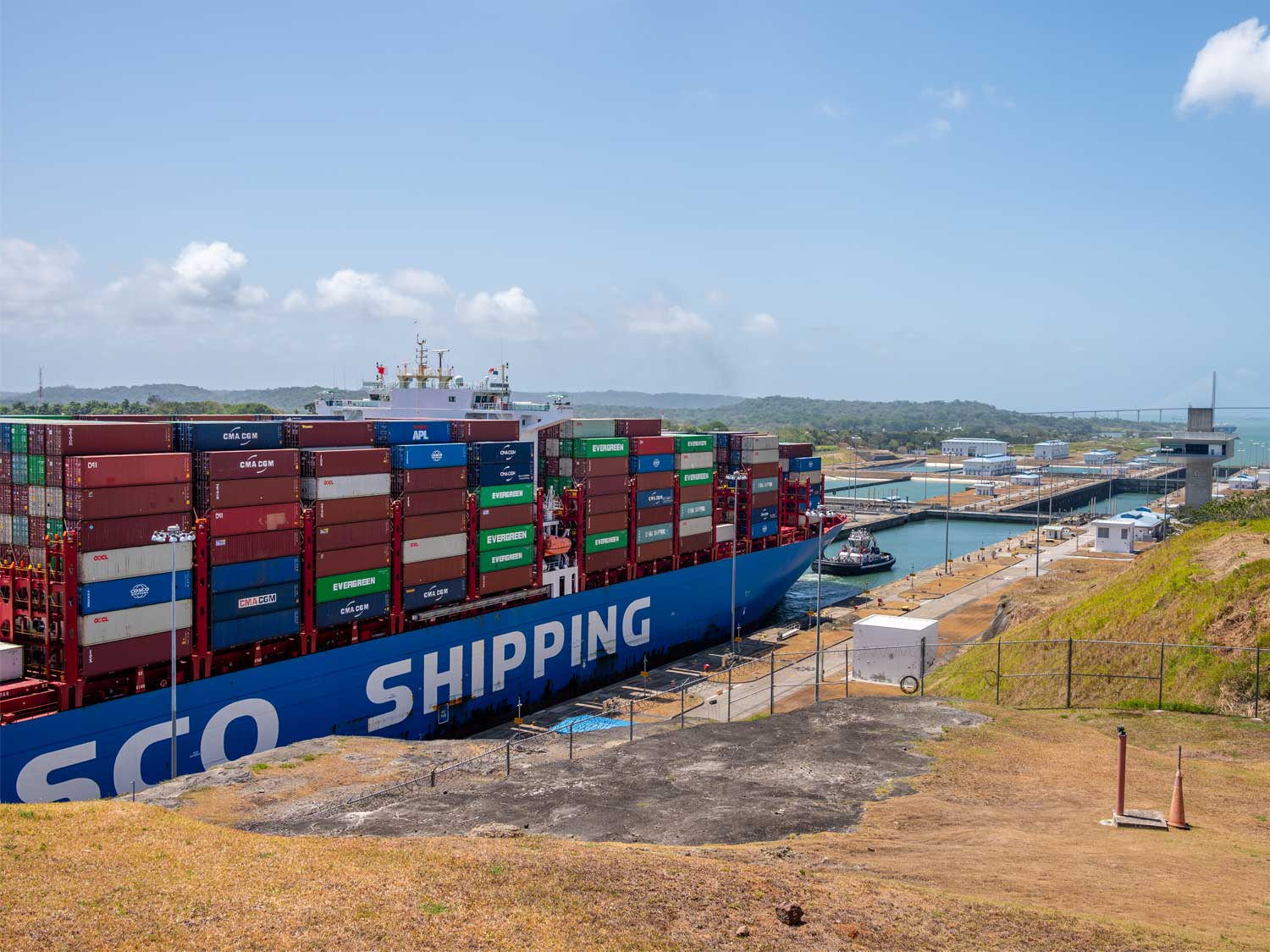
The Panama Canal is adding another significant factor for Asia–US East Coast and Gulf Coast services.

Water management measures are reducing the maximum permitted draft for vessels using the Neopanamax locks. The Canal has progressively tightened draft allowances during 2026 as it manages Gatun Lake water levels and prepares for the potential effects of El Niño.

The restrictions do not necessarily reduce the number of vessels able to transit each day. Instead, they do affect how many containers individual ships can carry. A lower maximum draft can force heavily laden containerships to reduce their loads before transiting, effectively removing container capacity from services even when scheduled sailings continue operating.

That matters because more than half of the Neopanamax vessels serving the US East and Gulf coasts currently transit Panama. The effect could therefore extend well beyond the Canal itself, tightening available space on some of the transpacific's most important services.

The Canal's normal Neopanamax specification allows a maximum draft of 50 feet, illustrating how progressively lower limits can constrain vessel utilisation.

Costs are beginning to reflect the restrictions

Carriers are already responding commercially. Several lines have announced Panama Canal surcharges for Asia–US East Coast and Asia–Gulf Coast cargo, with further charges scheduled to take effect from September.

These additional costs arrive as freight rates are already strengthening. With carriers controlling capacity through blank sailings and Canal restrictions potentially reducing the amount of cargo individual vessels can carry, there is less spare capacity available to absorb increases in demand.

The result could be a less volatile but structurally firmer transpacific market through the remainder of the traditional peak season. Rather than dramatic week-to-week movements, shippers could face sustained pressure on rates, space and equipment availability.

West Coast routings gain strategic importance

US West Coast services avoid the Panama Canal altogether, potentially giving shippers another option when East and Gulf Coast capacity becomes constrained. However, any significant diversion of cargo towards Los Angeles, Long Beach and other Pacific gateways could increase pressure on vessel space, port capacity, rail connections and inland transport.

That inland element is becoming particularly important because US trucking costs are rising sharply. National dry-van spot rates remain more than 40% above 2025 levels, while the average shipper-paid spot rate including fuel increased by almost 50% year on year in July.

Pressure is particularly evident around the West Coast gateways. In Los Angeles, outbound shipper-paid spot rates rose more than 50% year on year in July, as stronger inland movements from the country's largest container gateway coincided with reduced available trucking capacity.

Higher costs do not simply reflect stronger freight volumes. In some US regions, expenditure has increased substantially despite falling shipment volumes, demonstrating how capacity withdrawal, carrier pricing and operating costs can drive rates higher even when demand remains subdued.

US diesel prices are around 40% higher year on year, increasing carrier costs and fuel surcharge exposure. Less-than-truckload pricing is also strengthening, with general rate increases typically around 7% and some contract renewals moving into double-digit increases.

For transpacific shippers, this changes the calculation. Rerouting cargo through the West Coast may avoid Panama Canal restrictions and surcharges, but higher inland transport costs could offset some or all of the ocean freight advantage.

Metro connects Asia with a growing US network

The lowest ocean rate does not always deliver the lowest overall cost. With transpacific capacity tightening, Panama Canal restrictions adding complexity and US inland transport costs rising, shippers need to consider the entire journey across ocean, port, rail and road.

Metro's established Asian network and growing US footprint give shippers the flexibility to compare East Coast, Gulf Coast and West Coast options based on total landed cost, capacity, transit time and final destination. From securing ocean space and selecting the right gateway to coordinating inland transport and final delivery, Metro optimises the supply chain as a whole.

To learn more, EMAIL Managing Director Andrew Smith today.