
One Minute Late, Thousands Lost: U.S. Customs Tightens Enforcement Across All Modes

One Minute Late, Thousands Lost: U.S. Customs Tightens Enforcement Across All Modes

In U.S. trade compliance, even a one-minute delay can be costly. Recent cases show importers and logistics partners facing thousands of dollars in penalties simply because mandatory filings were completed moments after official cut-off times.

U.S. Customs and Border Protection (CBP) has stepped up automated monitoring across all major modes. For ocean freight, the Importer Security Filing (ISF-10) and manifest submissions must be lodged 24 hours before vessel loading. In airfreight, the Air Cargo Advance Screening (ACAS) system requires pre-departure data to be transmitted electronically before goods leave origin. And for trucking, particularly on north- and south-bound cross-border movements, the ACE eManifest must be filed at least one hour before arrival at the border. In all cases, late filings, even by seconds can trigger massive penalties or cargo holds.

The increased use of digital systems means there is now almost zero tolerance for timing errors. CBP’s automated compliance tools record submission times to the second, leaving little room for discretion or appeal.

This sharper focus on procedural precision comes amid a wider enforcement drive targeting customs fraud. In a separate case this month, two executives at a Los Angeles-based wholesale clothing importer were jailed and their company hit with a multi-million dollar fine for systematically under-valuing goods to reduce duties.

The message is clear: whether it’s filing times or declared values, compliance margins have all but disappeared.  To avoid finding yourself on the wrong side of a deadline lapse, it is critical that risks are mitigated:

  • Integrate automated alerts in your customs-filing systems so you’re aware of lead-time requirements well in advance.
  • Build a buffer into your internal processes: treat the submission cutoff as real time, and build in a buffer to allow for any delay.
  • Ensure your documentation and data (B/L numbers, consignee information, classification) are final and entered before the time cut-off — incomplete entries are a common cause of last-minute corrections and delay.

The Critical Take-Away

For businesses based in the UK or EU working with U.S. supply chains, this is a reminder that compliance deadlines are not just internal housekeeping, they carry real cost. When operational bottlenecks or last-minute changes push a filing even seconds late, the financial consequences can be large. Work closely with your U.S. customers and brokers to ensure that your entry process is streamlined, accurately filed and firmly upstream of any bottleneck.

Metro’s U.S. brokerage teams combine deep CBP compliance expertise with our advanced CuDoS customs automation platform, ensuring every declaration meets filing deadlines accurately and on time. EMAIL Andrew Smith, Managing Director, to learn how our integrated systems and on-the-ground U.S. presence can help safeguard your business and keep your supply chain fully compliant.

Carriers Pull Sailings and Add GRIs as US Port Fees Add New Cost Layer

Carriers Pull Sailings and Add GRIs as US Port Fees Add New Cost Layer

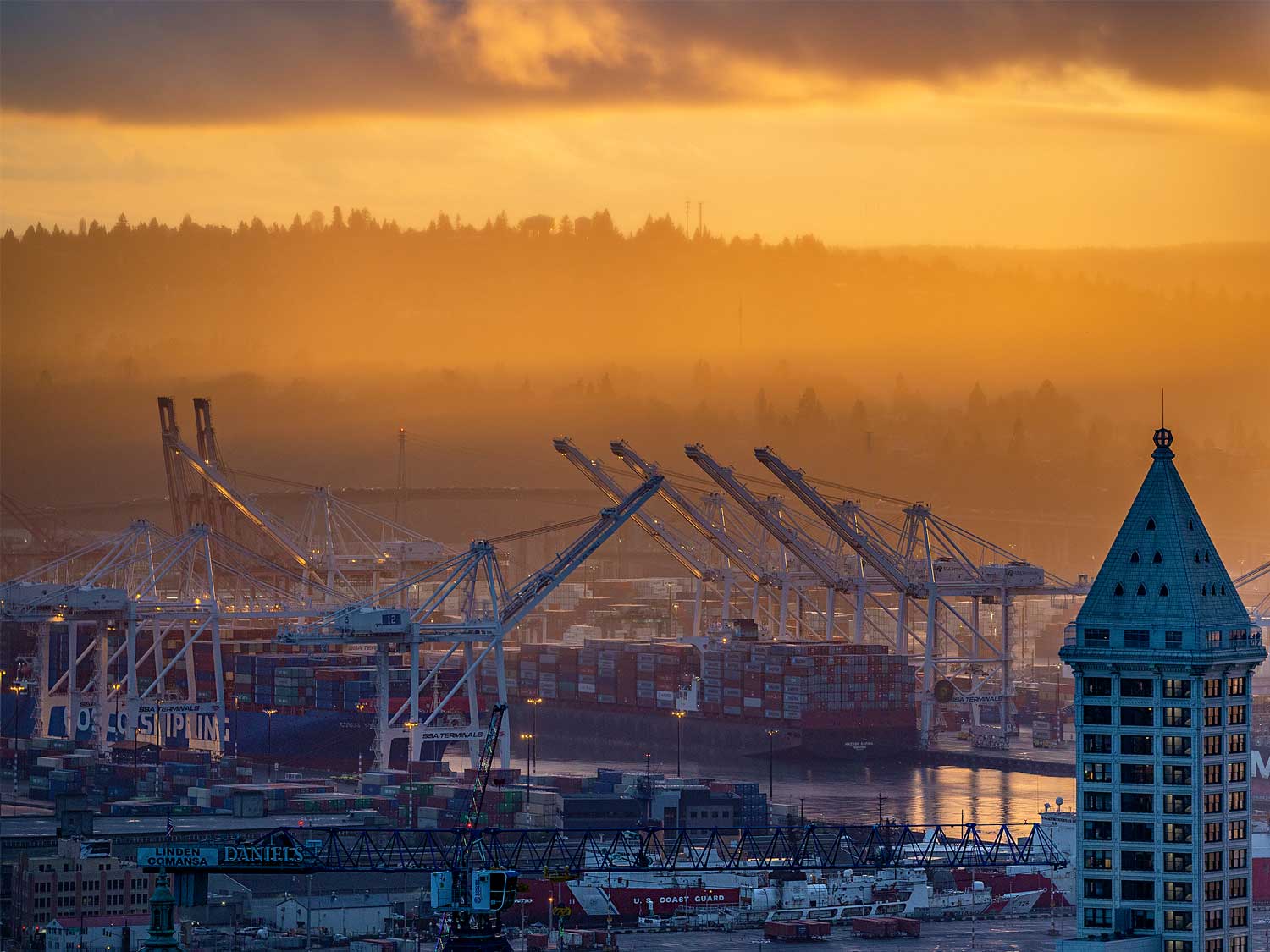
Container lines are tightening capacity to defend freight rates just as new U.S. port fees on China vessels start on 14 October—costs that carriers say will be passed through to shippers.

In the run-up to contracting season, the shipping alliances have stepped up blank sailings to support pricing. Between weeks 42–46, carriers withdrew 41 of 716 planned east–west sailings with the heaviest cuts on the transpacific and Asia–Europe corridors. It means that 6% of capacity, or 544,000 TEU have been stripped from transpacific and Asia–Europe trade-lanes over the past four weeks. 

Spot rates remain soft, with Drewry’s composite World Container Index dipping 1% in week 41, as carriers signal fresh GRIs of up to $2,300/teu and congestion/peak surcharges as they curb supply with voids and slow steaming.

USTR port fees are active

From 14 October, the United States is imposing USTR “special port service fees” on China-linked tonnage, with payment required in advance of arrival to avoid being denied lading, unlading or clearance.

For Chinese-owned/operated vessels, the fee starts at $50 per net ton, stepping up annually to 2028. For Chinese-built ships (not China-operated), the fee is the higher of $18 per net ton or $120 per discharged container, while foreign-built vehicle carriers face $46 per net ton from today.

What it means for shippers

  • The USTR regime adds a new fixed cost per container on top of base ocean rates and surcharges, and carriers are preparing pass-throughs.
  • With 6% of departures already pulled on main east–west trades and more voids likely, load factors are rising on the sailings that remain, which will add upward price pressure.
  • U.S. rules emphasise USTR pre-payment and proof on arrival, with non-compliance risks of port denial, cascading delays to inland supply chains and additional cost.

The container shipping lines are using their capacity and surcharge levers to prop up rates, while the USTR/China port fees, effective from last Tuesday, inject a non-market cost that will filter through to shippers. Expect more targeted blanks, GRIs with short notice, and more surcharges on Asia–Europe and transpacific flows into November.

At Metro, we work hand-in-hand with our network and carrier partners to keep cargo moving, even when the market is disrupted.

From time-sensitive shipments to sudden blankings, our sea freight team secure the right space to safeguard your supply chains and shield you from GRIs.

EMAIL Andrew Smith, Managing Director, today to explore how we can protect your US supply chains and insulate you from threatened GRIs.

Transatlantic Sea Freight Steadies

Transatlantic Sea Freight Steadies

The North Europe to US, transatlantic trade-lane, is settling into a more predictable rhythm, after a trade deal and took much of the guesswork out of export planning, while carriers have lifted reliability and held blank sailings to minimal levels. 

The result is a market where prices are easing but services are firmer, though the traditional peak looks unlikely.

Westbound volumes have risen 2% year on year, defying earlier expectations of heavy front-loading, while the slots deployed  by carriers are 7% higher than 2024, giving buyers more choice and competitive pricing.

On the reliability front, Europe toUS on-time performance has surged to 52% in Q2 vs Q1, with August the best month since October 2023.

Pricing pressure without panic

While price benchmarks are trending down they are not collapsing. 

Long-term deals signed over the prior three months are down under a third, while average spot rates fell 20% over the last three months. However, despite the softer prices, carriers have not resorted to large-scale blankings, a signal that underlying demand remains sound and that utilisation on sailing vessels is still healthy.

Service quality has moved decisively in the right direction. On-time performance on North Europe to US routes has improved from 24% in January to 58%, while the Mediterranean to US leg has nudged up from 24% to 36%. 

One alliance has consistently posted 92% reliability on the transatlantic in H1, far ahead of non-alliance services and standalone carriers (36%), underlining the advantage of integrated rotations. The challenge now is keeping performance high through winter weather and any land-side pinch points.

With inventories in better balance and retailers expecting low growth for winter, the consensus is no classic peak in late 2025. Expect stable demand, ample capacity and rates in range into year-end unless weather or labour disruptions intrude.

What shippers should do now

  • Prioritise services with proven on-time performance and shorter port strings to reduce dwell and downstream buffer stock.
  • Use today’s attractive rates to book core volumes and keep tactical headroom on spot.
  • Backhaul eastbound pricing remains sensitive so secure equipment and minimise roll risk.
  • The policy environment is calmer, but not static; maintain landed-cost models that can absorb incremental fees without re-quoting.

With long-established ocean carrier relationships, our team is helping clients secure space, optimise rates, and keep high-priority cargo moving on transatlantic lanes.

If your business depends on dependable transatlantic trade flows, EMAIL Andrew Smith, Managing Director, today to discover how expert guidance and tailored solutions can keep your supply chain agile and cost-effective, whatever the market brings.

Blank Sailings, GRIs and a Typhoon Disrupt Asia Shipping

Blank Sailings, GRIs and a Typhoon Disrupt Asia Shipping

Shippers moving goods out of Asia are bracing for the tightest space and schedule disruptions as the major container shipping lines accelerate blank sailings in the lead-up to China’s extended Golden Week holidays.

Following weeks of tentative planning, lines have now confirmed broad capacity withdrawals, cancelling between 14–17% of sailings on core Asia–Europe and Asia–US routes to offset softer demand amid seasonal and weather challenges.

The unprecedented combination of Golden Week and the Mid-Autumn Festival has pushed factory shutdowns to an eight-day stretch this year, pausing exports at the world’s manufacturing hub.

Just days before the holiday, Super Typhoon Ragasa hammered South China, triggering port closures, flight cancellations, and severe equipment shortages. Local experts now expect cargo backlogs and shipping delays to stack up for at least a week beyond the holiday’s official end, intensifying the regional congestion and supply chain volatility.

Carrier Alliances Adjust Rapidly

Analysis of carrier announcements reveals distinct strategies among the largest ocean alliances. Early movers blanked sailings soon after market signals softened, while others opted for aggressive, late-stage cuts in the final pre-holiday weeks. Whether by steady withdrawals or front-loaded cancellations, overall capacity reductions are now on par with historical Golden Week patterns, yet the scale and timing of adjustments this year dwarf previous years and reflect the urgent need for carriers to rebalance supply with dampened demand.

In parallel with capacity cuts, carriers are moving to restore profitability through new general rate increases (GRIs). One major line has announced GRIs effective from early October:

  • Far East–North Europe: $1,200 per 20ft and $2,000 per 40ft.
  • Far East–West Mediterranean: $1,750 per 20ft and $2,500 per 40ft.
  • Far East–East Mediterranean: $1,800–$2,150 per 20ft and $2,600–$2,700 per 40ft, depending on destination.

Meanwhile, another leading carrier has confirmed a peak season surcharge on the westbound transatlantic, at $400 per 20ft and $600 per 40ft.

These surcharges highlight how quickly pricing can swing when capacity is withheld and seasonal demand shifts.

Adding to the disruption, last week’s Typhoon Ragasa forced widespread factory closures and halted container movements across South China. Surges in trucking and equipment charges at origin have been exacerbated by the post-typhoon scramble.

Why Carriers Blank Sailings

Blank sailings, a carrier’s decision to skip or cancel specific port calls, or even entire voyages, are a crucial tool for controlling costs and freight market stability. These cancellations can occur due to falling demand, port congestion, storms, mechanical breakdowns, or as part of a calculated strategy to support freight rates in an oversupplied market.

Blank sailings happen for several reasons:

  • Low demand – such as after Chinese New Year or Golden Week.
  • Port congestion – strikes, bottlenecks, or canal delays.
  • Weather disruptions – storms or unsafe docking conditions.
  • Mechanical issues – urgent vessel repairs.
  • Market strategy – cutting supply to stabilise freight rates.
  • Regulatory or political disruption – new rules or regional instability.

The Shipper’s Challenge

Blank sailings mean longer lead times, unpredictable offloads, and more frequent cargo rollovers. Freight may get rerouted, remain at origin for extended periods, or be consolidated on later vessels, driving both and planning complexity up.

To keep shipments moving and mitigate delays, shippers should:

  • Build more time buffers into supply chain schedules during holiday and storm periods.
  • Use tracking and analytics tools for early indications of disruption.
  • Diversify carriers, prioritising reliability and fast rerouting capabilities.
  • Communicate proactively about possible delivery delays.
  • Explore alternative transport modes for urgent consignments.

With volumes likely to stay subdued until the seasonal year-end surge, further blank sailings could be triggered in response to lingering congestion and uneven recovery.

The weeks ahead demand vigilance, agility, and close collaboration.

At Metro, we work hand-in-hand with our network and carrier partners across China to keep your cargo moving, even when the market is disrupted. From time-sensitive shipments to sudden blankings, our sea freight team finds the capacity and alternative solutions you need.

By sharing forecasts on critical dates and volumes, you’ll help us secure the right space to safeguard your supply chains and shield you from looming GRIs.

EMAIL Andrew Smith, Managing Director, today to explore how we can protect your ex-Asia supply chains and insulate you from threatened GRIs.