Lloyds Market Matters

Metro CEO joins Lloyds Bank to examine the changing global trade outlook

Metro CEO Grant Liddell joined Lloyds Bank’s Markets Matter briefing to examine how geopolitical disruption, changing sourcing strategies and rising transport costs are reshaping global supply chains and why underlying trade remains surprisingly resilient.

The Lloyds Bank’s Markets Matter series brings together its economists and market specialists with business leaders to give corporate and commercial clients practical insight into the economic, financial and operational issues affecting their businesses.

For its latest briefing, Navigating Markets Beyond Monetary Policy, Grant joined Lloyds Bank specialists to bring a logistics perspective to a discussion spanning interest rates, inflation, energy prices, government finances and the wider risks facing UK businesses.

With freight costs among the channels through which geopolitical disruption and higher energy prices can feed into inflation, the discussion turned to what Metro is seeing across international supply chains and how businesses are responding.

Global trade is proving resilient

Global logistics provides an unusually immediate barometer of international trade, and Grant highlighted the contrast between the economic headlines and what is actually moving through supply chains.

Global container volumes reached a record level during July, while containerised trade continued to grow year on year. Intra-Asia and Asian export trades have been particularly strong, despite tariffs, geopolitical tensions and changing sourcing patterns. 

The picture is not uniform. European demand remains relatively subdued compared with the US, Far East and some emerging markets, while India is experiencing particularly strong growth.

That demand has consequences. Freight operates as a highly responsive market, with rates capable of rising or falling rapidly as available capacity moves out of balance with cargo demand. Grant highlighted dramatic increases on some Indian ocean and airfreight trades this year, while transpacific ocean rates have returned towards levels last experienced during the pandemic. 

Those increases do not stop with the freight invoice. Components and raw materials frequently cross borders several times before a finished product reaches its customer. Higher transport costs can therefore enter the production process at multiple stages, creating an indirect inflationary effect as well as increasing the final cost of distribution. 

From just in time to ‘just given time’

One of Grant’s most interesting observations concerned the way businesses are responding to disruption.

The highly optimised just-in-time model used across many manufacturing and industrial sectors has become much harder to maintain as Red Sea diversions, geopolitical conflict, closed airspace and port congestion extend and destabilise transit times.

Grant described the reality as increasingly becoming “just given time” with businesses adapting their inventory and production strategies to supply chains where predictable lead times can no longer always be assumed. 

That change is also accelerating interest in alternative sourcing locations. India is attracting manufacturing in sectors including technology and electronics, while Metro customers are increasingly considering production in the UK and Europe. North Africa is becoming more prominent and Turkey has attracted manufacturing across garments, automotive and engineering.

Some businesses had already begun reducing their dependence on China before the pandemic. Subsequent disruption has pushed resilience and diversification much higher up the agenda.

Yet this does not necessarily mean less international trade. Goods may travel shorter distances or move by truck rather than deep-sea container or airfreight, while rapidly expanding intra-Asian trade demonstrates how changing manufacturing footprints can create new freight flows rather than eliminate them. 

Reliability becomes the critical supply-chain risk

Asked what businesses should be considering as they plan for 2027, Grant put reliability high on the list.

Strong demand is combining with congested ports, delayed vessels, weather disruption and geopolitical uncertainty. The resulting challenge is not simply securing a competitive freight rate, but ensuring components reach production lines and finished products reach markets when required. 

That reinforces a theme running throughout the Lloyds discussion.

Higher freight and energy costs matter, but their wider economic impact depends partly on how businesses respond: whether costs are absorbed, reflected in pricing, influence wage decisions or become embedded in future contracts.

For supply-chain managers, the equivalent challenge is building enough flexibility into sourcing, inventory and transport strategies to withstand disruption without creating excessive cost.

Suez could change the equation again

There are also reasons why the freight outlook could change during 2027.

Grant highlighted the increasing use of the Red Sea and Suez route by carriers serving Asia, with several lines already using the route regularly.

A wider return would release effective vessel capacity because ships would no longer require the additional 15+ days associated with Cape of Good Hope diversions. That could improve supply and place downward pressure on freight rates. 

But the outlook remains complicated by energy prices, aviation fuel costs and continuing geopolitical risk.

Near-shoring can provide another layer of protection, but changing a manufacturing footprint is neither quick nor straightforward. Establishing new suppliers and supply chains can take months or years.

The result, as Grant characterised it, is a mixed picture for 2027, and while significant risks remain businesses are actively changing how and where they source, manufacture and move products to manage them. 

Turning global risk into practical supply-chain decisions

Perhaps the clearest message from the discussion was that geopolitical and economic uncertainty has not stopped global trade. Instead, it is changing its routes, costs and priorities.

With businesses already planning for 2027, the discussion provides useful context for understanding how economic and geopolitical risks could affect costs, sourcing and supply-chain decisions in the months ahead.

Click HERE to catch up with the full Lloyds Banking Group Markets Matter recording.
Forklift loading container

Asia–UK ocean market faces volatile October as capacity shifts

UK importers face an unusually volatile October as falling Asia–Europe freight rates collide with excess scheduled capacity, returning Suez services, short-notice blank sailings and continuing disruption across Asian ports.

Ocean carriers are attempting to halt a 12-week decline in Asia–Europe rates with increases planned for the second half of October. However, the traditional slowdown following China's Golden Week (1–7 October) could make those increases difficult to sustain unless carriers withdraw significant capacity.

For shippers, lower underlying demand may therefore bring temporarily cheaper freight but not necessarily more reliable supply chains.

Golden Week creates a capacity imbalance

Asia–North Europe scheduled capacity is unusually high. Around 1.5m TEU is scheduled across the four-week Golden Week period, 27% more than last year and 60% above pre-pandemic averages.

But those figures overstate the amount of genuinely new capacity entering the market.

Typhoon disruption and severe congestion at Chinese ports have pushed vessels significantly behind schedule. As delayed ships return to service alongside their normally scheduled counterparts, 12 double sailings are expected across Asia–Europe and Mediterranean services during the first two weeks of October.

At the same time, Golden Week factory closures will reduce export volumes.

The result could be a rapid shift from constrained effective capacity to temporary oversupply as delayed vessels return and cargo volumes fall.

Carriers are likely to respond with significant blank sailings, potentially announced at relatively short notice. That could leave mid-to-late October schedules particularly vulnerable to cancellations, rolled cargo and departure changes.

Suez return adds more effective capacity

The gradual return of Asia–Europe services to the Suez Canal adds another variable.

Faster Suez routings effectively release vessel capacity because ships can complete round voyages considerably faster than when sailing around the Cape of Good Hope.

Asia–North Europe services remain cautious, but the shift is gathering pace. Around 30% of backhaul capacity was using Suez during September, with this expected to reach approximately 40% in October.

Several additional services are now moving back to the canal, primarily to return delayed vessels to Asia more quickly following severe port congestion.

For UK importers, increased Suez utilisation could eventually support shorter transit times and greater capacity. In the immediate term, however, changing vessel rotations and the possibility of further network adjustments add even more uncertainty to schedules.

Security conditions in the Red Sea also remain fluid, meaning carriers retain the option of reverting to Cape routings if their risk assessments change.

Reliability remains the bigger concern

Freight rates from Asia to North Europe have been under pressure for some time, which is why carriers have announced increases for the second half of October in an attempt to reverse that trend.

But price is only part of the equation. Multiple typhoons in seven weeks created severe disruption at Shanghai, Ningbo-Zhoushan and Yantian, with berthing delays extending up to 14 days, with on-time performance on services falling to just 62% in August, while average delays for late Asia–Europe vessels reached five days.

Residual disruption is expected to continue through October as vessel bunching, accumulated container backlogs and post-Golden Week capacity adjustments work through the network.

The immediate risk for UK importers is therefore less about a shortage of nominal vessel capacity and more about whether booked capacity operates when expected.

European disruption adds another risk

Conditions at destination also require attention. German port workers are currently voting on authorisation for indefinite strike action after rejecting the latest employer wage offer. The ballot closes on 1 October, with Hamburg, Bremen, Bremerhaven and other major German ports potentially affected if industrial action follows.

German freight interests are already preparing for possible restrictions affecting terminal handling and pre- and on-carriage.

While this does not directly affect UK ports, significant disruption at major North European gateways could create wider network effects as carriers adjust rotations and cargo moves through alternative ports.

The transatlantic market is moving differently. Europe–US East Coast spot rates remain substantially above last year's levels, while carriers are managing winter capacity through blank sailings. This makes early allocation planning particularly important for exporters relying on North Atlantic services.

Flexibility will matter through Q4

October therefore presents an unusual combination for Asia–UK shippers.

Underlying rates are soft, substantial scheduled capacity is entering the market and shorter Suez routings are gradually restoring effective vessel supply. Yet congestion, poor schedule reliability and likely carrier capacity management mean the operational environment could remain unpredictable, with rates likely to harden.

Shippers should consequently avoid interpreting softer rates as a signal that the market has normalised.

Metro's established carrier relationships and extensive global network give our teams access to multiple services, routings and consolidation options across the Asia–UK trade. By monitoring capacity, schedules and gateway conditions, we can identify alternatives when blank sailings, congestion or network changes threaten planned movements.

Talk to Metro about your Q4 Asia–UK requirements and how alternative carriers, routings and consolidation options can provide greater flexibility as the market adjusts.

Aircraft and moon

Airfreight market strengthens as peak season nears

Global air cargo demand and rates are strengthening ahead of the traditional peak season, with rising volumes, firm pricing and higher fuel costs creating a more robust market as October begins.

The latest TAC Index and WorldACD data point to increasing momentum as the industry moves towards its busiest months, although conditions continue to vary significantly by trade lane.

The global Baltic Air Freight Index gained a further 0.6% in the seven days to 28 September, extending a series of modest weekly increases and leaving rates nearly 22% above the same point last year.

Meanwhile, WorldACD recorded a fourth consecutive weekly increase in global chargeable weight in week 38, with tonnages rising 2% week on week and 8% year on year.

Demand builds across major origin markets

The underlying demand picture is increasingly positive. Asia Pacific remained one of the strongest contributors, with origin tonnages 11% higher year on year. North American volumes increased 14% week on week following the Labor Day dip and were 8% above last year's level, while European origin volumes were 6% higher year on year.

Rates are also substantially above 2025 levels. WorldACD's average worldwide full-market rate was 24% higher year on year in week 38, while average spot rates were 33% higher.

Asia Pacific spot rates were 30% above last year, with Europe up 29% and North America 34%.

TAC Index data for the following week suggests that firmness continued into the end of September, with its global index extending its year-on-year increase to 21.7%.

The backdrop is being reinforced by significantly higher fuel costs. TAC reported that jet fuel prices were 106% above their level a year earlier by 25 September, adding another source of upward pressure as the market approaches peak.

Asia markets gather momentum

Asia is likely to be central to the developing peak-season picture. TAC recorded a 3% weekly increase in its Hong Kong outbound index during the week to 28 September, taking it 20.6% above last year. Rates from India also increased strongly, while China-Europe pricing continued to firm as the market adjusted following changes affecting low-value parcel traffic.

WorldACD similarly recorded further increases in Asia Pacific-Europe spot rates during week 38, including gains from mainland China, Hong Kong, Japan and South Korea.

The transpacific remains particularly strong. Asia Pacific-US demand was 13% higher year on year, including significant growth from South Korea, Japan and China. Average spot rates on the trade were broadly stable week on week but approximately 40% above their level a year earlier.

The picture towards Europe is more mixed. China and Hong Kong volumes have yet to recover fully from the disruption that followed the removal of the EU de minimis exemption in July, but pricing has begun moving higher on several key origins.

Golden Week adds to peak-season pressure

Attention is now turning to China's National Day Golden Week (1–7 October), which follows closely behind the Mid-Autumn Festival (25–27 September) and compresses production, export handovers and freight planning into a short period.

Metro’s local partners are already reporting stronger general cargo demand from North China as shippers move goods before the holiday, while transpacific demand from Southern China is also increasing.

Available capacity and additional charter operations have so far helped contain more dramatic rate movements. However, the combination of recovering volumes, firm year-on-year pricing, higher fuel costs and the traditional Q4 uplift creates the potential for conditions to tighten further as October progresses.

Worldwide international capacity was only 4% higher year on year in week 38, compared with an 8% increase in tonnage. Capacity also remains constrained in some markets affected by geopolitical disruption, particularly the Gulf.

Early planning for the Q4 peak

The latest figures do not point to a uniform capacity squeeze, but they do suggest that the airfreight market is entering peak season from a considerably stronger position than a year ago.

With demand building, rates already elevated year on year and conditions varying sharply between origins and trade lanes, access to the right capacity at the right time will become increasingly important through the final quarter.

Metro's global airfreight network, carrier relationships and flexible routing options help customers secure capacity and respond quickly as market conditions change. 

If you have time-critical, high-value or peak-season shipments planned for Q4, talk to our airfreight team about protecting capacity and keeping cargo moving.

HKG port

Asian port congestion could disrupt supply chains well into 2027

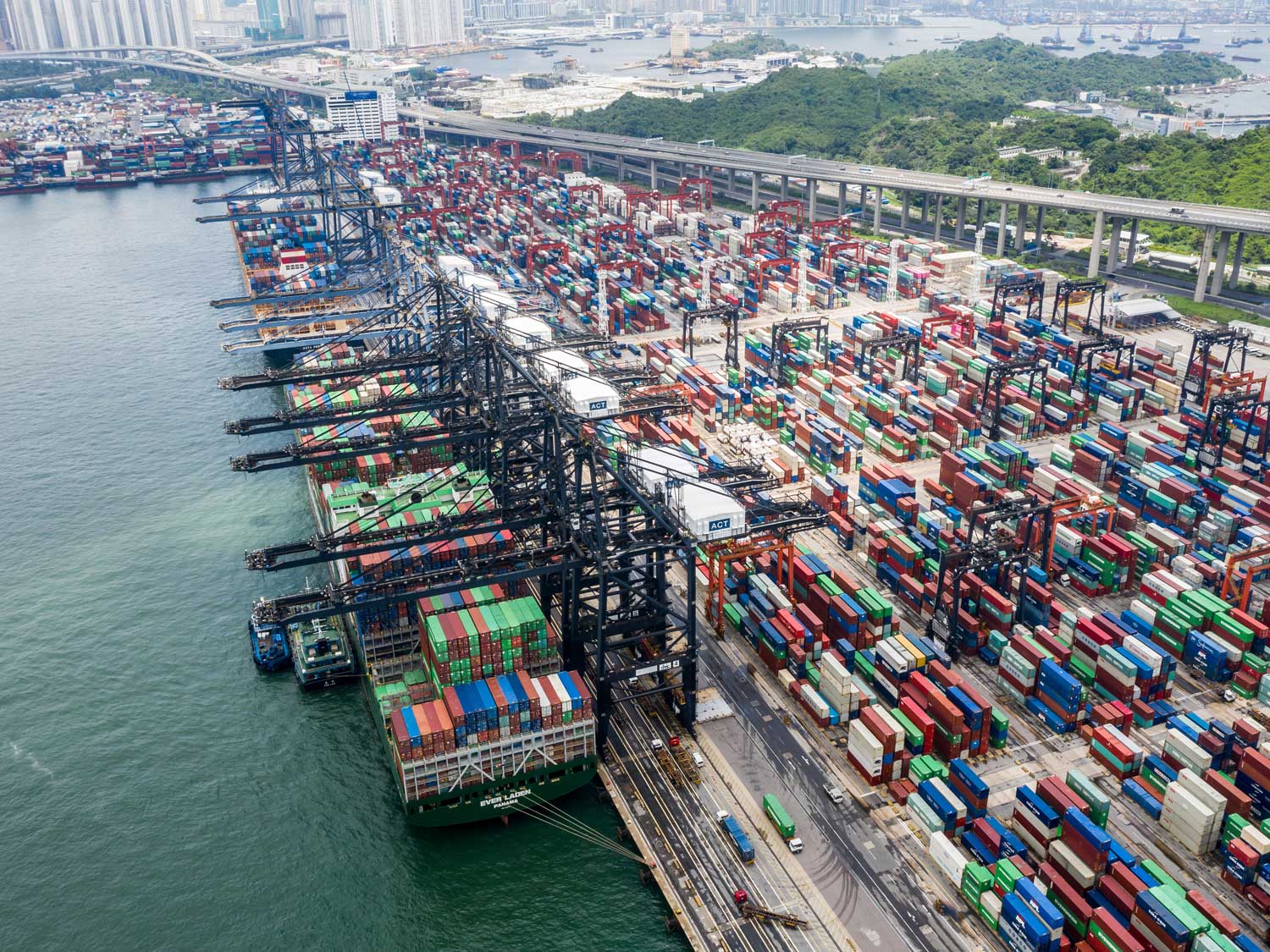
Severe congestion across Asian container ports is tying up millions of TEU of capacity, driving schedule reliability to a four-year low and raising the prospect of disruption continuing well into 2027.

Repeated typhoons, strong Asian export demand and congestion spreading between ports have created disruption comparable in scale with the peak of the pandemic.

While conditions should improve as weather disruption eases, analysis of previous congestion cycles suggests clearing the accumulated vessel and container backlogs could take considerably longer.

Sea-Intelligence estimates it could take up to ten months for congestion to return to the levels recorded in June 2025, potentially leaving supply chains dealing with the consequences through the first half of next year.

Reliability falls as capacity gets trapped

The immediate impact is already visible in global shipping schedules. Schedule reliability fell another 5.9 percentage points in Sea-Intelligence's September report to 49.9%, its lowest level since September 2022 and the second consecutive significant monthly decline.

Late vessels are also getting later. Average delays increased by 0.6 days to 6.81 days, the highest since March 2022 and almost two days longer than a year earlier.

Estimates of the amount of capacity affected vary according to methodology and timing, but indicate the scale of the problem. Around 3.9m TEU is currently caught up in global port congestion, returning congestion volumes to levels last experienced in 2022.

Sea-Intelligence calculates the disruption is absorbing around 8.5% of the global containership fleet, effectively removing millions of TEU of usable vessel capacity from the market.

That helps explain why the industry's substantial influx of new vessels has yet to translate fully into available capacity. Ships waiting outside ports or arriving significantly behind schedule cannot provide the capacity their nominal deployment suggests.

Disruption spreads across Asian networks

Weather has been an important catalyst. Repeated typhoons have reduced effective port capacity at major Chinese gateways at the same time as strong export demand has increased pressure on terminals.

But congestion rarely remains confined to the port where the original disruption occurs.

Late vessels arrive together at subsequent calls, creating bunching and additional terminal pressure. Carriers may respond by omitting badly affected ports, but that can simply transfer containers and vessel calls to alternative gateways and transhipment hubs.

Some of that pressure is already shifting towards Southeast Asia and the Indian subcontinent.

The distortion can also make scheduled capacity figures misleading. Asia–North Europe deployment around Golden Week reached around 1.5m TEU over four weeks, approximately 27% higher year on year and 60% above pre-pandemic averages.

Rather than representing a straightforward increase in available space, part of that apparent capacity reflects vessels bunching as disrupted schedules overlap.

Rates reflect shrinking effective capacity

The consequences are particularly visible within Asia. Drewry's Intra-Asia Container Index has reached record territory as Golden Week demand meets restricted effective capacity. Shanghai–Laem Chabang increased 22% in its latest assessment, while Shanghai–Jakarta rose 12%.

The impact extends further afield. Asia–US rates remain close to pandemic-era records, while charter markets are also signalling exceptionally tight vessel availability.

This creates an important distinction for shippers: deployed capacity and usable capacity are not the same thing.

Even as carriers receive new vessels, congestion can absorb that additional capacity before customers see the benefit through improved availability, reliability or pricing.

The landside challenge could last longer

Port congestion also has consequences beyond vessel schedules. For individual shippers, reliability ultimately depends on when cargo actually becomes available and reaches its destination. Vessel bunching can create sudden surges in container volumes through terminals, rail connections, depots and road networks.

Those supporting networks cannot expand as quickly as vessel capacity.

Terminal, rail and road infrastructure requires long-term investment, while operators also need to maintain high asset utilisation. That leaves less spare capacity available to absorb sudden spikes following weather disruption or vessel bunching.

The result can be a second wave of delay after a vessel reaches port, particularly where terminals and inland networks are already operating close to capacity.

Chinese New Year becomes the next pressure point

The length of the potential recovery is therefore significant.

Based on recovery patterns following the pandemic and the initial Red Sea disruption, Sea-Intelligence estimates congestion could take six to eight months simply to return to conditions seen at the end of 2025, and 10 months to return to the much lower levels recorded in June 2025.

That timeline extends beyond Golden Week and potentially into the next major Asian shipping peak.

Chinese New Year falls on 6 February 2027, meaning the traditional pre-holiday cargo rush could arrive before networks have fully cleared today's disruption.

For shippers planning Q4 movements and early 2027 supply chains, advance bookings, realistic transit assumptions and flexibility around routing and gateways could therefore remain important well beyond the current congestion peak.

Keeping cargo moving when networks tighten

Metro combines established global carrier relationships with extensive origin, destination and inland capabilities, giving our teams the flexibility to respond when congestion disrupts established shipping patterns.

Through consolidation services, alternative carrier and routing options, gateway selection and coordinated inland transport, we can assess the complete movement rather than relying on a single service or routing.

With Asian congestion potentially affecting capacity and schedules well into 2027, talk to Metro about upcoming movements and the options available to protect space, maintain visibility and build greater flexibility into your supply chain.